Li Keran
Introduction
Li Keran (1907-1989) was a prominent Chinese painter, recognized as a transformative figure in the evolution of Chinese ink painting during the 20th century. His innovative approach to traditional landscape painting and calligraphy earned him a revered place in art history. Li's works epitomize a unique blend of classical Chinese aesthetics with modern techniques, expanding the horizons of the ink-brush medium. His influence extends beyond his paintings, as he played a pivotal role in nurturing and mentoring the next generation of ink painters, establishing what is known today as the "Li school" of landscape painting. His commitment to the artistic tradition and innovation continues to inspire artists and audiences around the world.
Early Life and Education
Born in Xuzhou, Jiangsu province, Li Keran grew up in a time of cultural and societal transformation in China. Despite being born to illiterate parents, he pursued an education in the arts, an endeavor that would shape his path significantly. Li studied at the Hangzhou Fine Art School, now known as the China Academy of Art, under the tutelage of Lin Fengmian. Lin, who had studied in France, was dedicated to merging Chinese and Western art philosophies. This exposure allowed Li to explore beyond the traditional confines of classical Chinese painting and embrace a broader artistic perspective. His early education equipped him with the skills and vision to revolutionize Chinese ink painting, as he became acquainted with oil painting and other Western techniques, which he adeptly infused into his ink-brush work.
Artistic Style
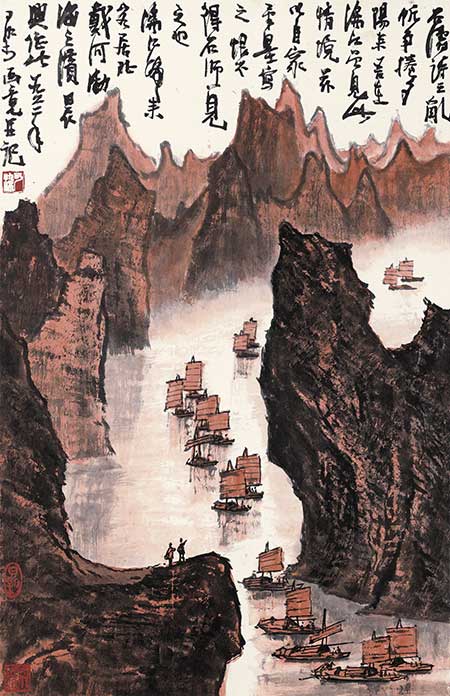
Li Keran is celebrated for his innovative artistic style, which marries the traditional elements of Chinese landscape painting with modern sensibilities. He embarked on extensive sketching travels across China, drawing inspiration from the country's diverse natural landscapes. This immersion in nature enabled him to develop a distinctive brushstroke style, capturing the essence of China's scenery and reflecting societal changes. His landscapes are noted for their dynamic compositions, where the interplay of light and shadow, ink and water, creates a mesmerizing visual experience. Li Keran's works are characterized by a sense of historic grandeur and romanticism, often portrayed with a spiritual undertone that transcends the ordinary depiction of nature. He strategically incorporated influences from traditional Chinese artists like Huang Binhong and Qi Baishi, yet charted his unique course, distinguishing his art with profound philosophical insights.
Major Works
Paintings
Li Keran's oeuvre includes numerous significant paintings, many of which have become iconic representations of modern Chinese art. Among his notable works is Sacred Shaoshan Mountain, painted in 1974. Another significant creation is Huangshan Mountain, completed in 1979, where Li captures the majesty of this renowned natural site with his masterful ink technique. Spectacular Scenery, another exemplary piece, showcases Li's skill in using ink to portray serene landscapes, emphasizing the beauty and tranquility of nature.
Calligraphy
In addition to his prowess as a painter, Li Keran was an accomplished calligrapher. His calligraphic works demonstrate a deep understanding of traditional Chinese calligraphy, which he practiced diligently alongside his painting. Li's calligraphy reflects his belief in the importance of mastering traditional techniques, serving as a foundation for creative expression. His inscriptions often accompanied his paintings, enhancing their aesthetic and cultural value. Li's dedication to calligraphy was not just a testament to his skill but also an embodiment of his holistic approach to art, where painting and calligraphy are intertwined in a harmonious dialogue.
Influence and Legacy
Li Keran's influence on Chinese art is profound and far-reaching. He is credited with revitalizing the tradition of Chinese ink painting, ushering it into a new era of openness and inclusivity. His establishment of the "Li school" of landscape painting has ensured the continuation of his innovative spirit, as younger generations of artists build on his legacy. Li's approach to art, which emphasized the importance of life observation, sketching, and the synthesis of tradition and modernity, has inspired countless artists. His studio, Shi Niu Tang, became a symbol of his dedication and creativity, witnessing the birth of many of his masterpieces. Li's impact extends beyond his lifetime, as his works and teachings continue to shape the trajectory of Chinese ink painting today.
Awards and Honors
Throughout his illustrious career, Li Keran received numerous accolades that recognized his contributions to the arts. His reputation as one of the foremost figures in 20th-century Chinese art is well-established, with honors conferred for both his artistic achievements and his role in art education. As the founding director of the China National Academy of Painting, Li Keran played a crucial role in shaping the institution's mission to preserve and innovate classical Chinese painting. His legacy is celebrated through exhibitions and retrospectives that honor his life's work, cementing his status as a master of Chinese ink painting.








